

Part 1 of this series covered how we keep existing boilers, geothermal systems, and light commercial heating running. This post focuses on what happens before that: designing and installing the system from the ground up. That might mean adding it to a custom home during framing, replacing a heating system during a remodel, or bringing geothermal comfort to a property for the very first time.
Janes Radiant Heating began with installation. We were the Seattle area’s first major provider of radiant floor heating products and installation. Since 1986, we’ve installed systems in custom homes, multifamily buildings, and commercial properties throughout Puget Sound (from Gig Harbor and Tacoma to Port Angeles, Bellevue, and Bellingham), becoming Washington state’s largest radiant heating installer.
Radiant Floor Heating Installation for New Construction and Retrofit
Radiant floor heating installation works best when it’s planned early, though it doesn’t have to start at the foundation. We design and install systems for two very different project types, and the approach changes depending on which one you’re in:
 New construction radiant heat: Installed before and during framing, this is the ideal scenario. Tubing is embedded in the slab or laid beneath the subfloor before the finished flooring goes down, giving you plenty of flexibility with zoning, manifold placement, and mechanical room layout. There’s no demolition or cutting into finished spaces, and the system becomes a seamless part of your home’s design rather than an add-on.
- Retrofit and remodel radiant heat installation: For existing homes, we design around what’s already there, often installing thin-profile radiant panel systems above the existing subfloor, or using a staple-up method for upper floors or homes with crawlspaces. It costs more to retrofit than to build in from day one, but it’s a common and well-proven path, especially during a whole-floor remodel.
Every radiant heat installation runs on an energy source; it’s important to know what fits the property and the homeowner’s goals: natural gas, oil, electric, propane. Then we plan whether someone wants to use a high-efficiency boiler, a geothermal system, or an air-to-water heat pump system. That flexibility is a big part of why radiant has grown from a niche upgrade into a mainstream choice for homeowners who want even, quiet, allergen-free heat instead of forced air. It’s also a widely documented one: the U.S. Department of Energy’s Energy Saver guide to radiant heating is a good independent resource for homeowners comparing radiant to forced-air options.
Geothermal Heating System Installation
Geothermal is one of the most efficient ways to heat a home, using the stable, year-round temperature of the earth instead of outside air. A ground-source geothermal installation involves three main components working together, and we design and install all of them as a single system: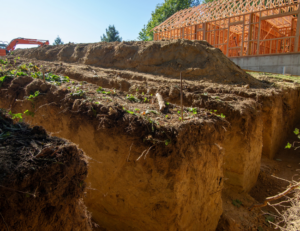
- The ground loop, a buried network of pipe (horizontal or vertical, depending on the lot) that exchanges heat with the earth.
- The geothermal heat pump, the equipment that extracts heat from the loop and delivers it to the home.
- The hydronic distribution system: radiant floors, panel radiators, or a combination, sized and zoned for the building.
Because a geothermal heating system needs to be installed underground and throughout the home in stages throughout construction, it’s not a system most HVAC companies are set up to install correctly from end to end. It’s exactly the kind of project our team designs for regularly: new construction homes built around a geothermal system from the start, and retrofit installations where an existing property is being upgraded to ground-source heat.
Air-to-Water Heat Pump Installation
For homeowners who want geothermal-level comfort and efficiency without a loop field, an air-to-water heat pump is often the right answer. Instead of exchanging heat with the ground, these systems pull heat from the outside air and transfer it into a hydronic system: the same radiant floors, panel radiators, or baseboard that a geothermal or boiler-based system would use. Air-to-water works amazing in our area’s temperate winters, but are still efficient even if temperatures drop into the negatives.
Air-to-water heat pump installation has become one of the fastest-growing requests we get, for a few clear reasons: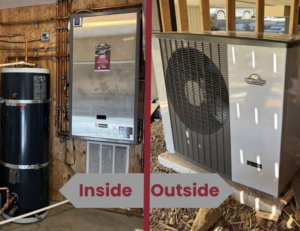
- No ground loop required, the air to water heat pump sites quietly outside and is a perfect alternative option on lots where drilling or excavation isn’t practical.
- Strong efficiency in Western Washington’s climate, which rarely sees the extreme cold that limits air-source performance in other parts of the country.
- Compatibility with existing hydronic distribution, making it a strong retrofit option for homes already set up for radiant heat or hydronic radiators.
- Cooling potential worth exploring: some air-to-water systems can also provide cooling alongside heating and domestic hot water. It’s not something we lead with today, but it’s a good conversation to have with a designer if year-round comfort from one system is a goal for the property.
Sizing and installing an air-to-water heat pump correctly means understanding both the equipment side and the hydronic side of the heating system: the same dual expertise our technicians are trained on for geothermal work.
Why Builders and Homeowners Choose Janes Radiant for Installation
Whether the project is a single custom home, a multifamily development, or a light commercial building, our installation process is built around a few consistent things: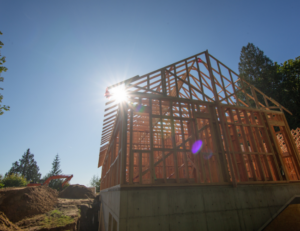
- In-house design, not a one-size-fits-all layout: every system is sized and zoned for the specific building.
- Direct experience with natural gas, oil, electric, propane, geothermal, and air-to-water systems, so the fuel and equipment decision is based on the property, not on what one crew happens to know.
- A track record builders can rely on, working alongside general contractors on new construction timelines without becoming the delay.
- The same team for install and service, so a system installed by Janes Radiant stays supported for the long run.
If you’re planning a new build, a remodel, or an upgrade to use an hydronic heating system, reach out to start the design conversation. We’ll walk through the property, the goals, and the right system to get there.
Next in this series: How Janes Radiant supports do-it-yourself installers and contractors with radiant heat kits nationwide.